Best Toy Engine to Build: Top Hands-on STEM Models for Kids and Adults
Explore a curated set of engaging toy engine kits that let builders of all ages assemble, observe, and interact with functioning engine models. From small V8 replicas to multi-cylinder assemblies and even remote-controlled engines, these kits blend education with entertainment. Each option below is selected to illustrate different scales, complexities, and learning experiences—from beginner-friendly disassemblies to intricate builds that run and respond to real-world mechanisms. Use this guide to compare features, assembly difficulty, and how each kit supports STEM curiosity in the classroom or at home.
| Product | Pieces | Approx. Audience | Key Benefit |
|---|---|---|---|
| Playz V8 Combustion Engine Model Kit | 270 | Adults & Teens 12+ | Working, audible engine with hands-on assembly |
| V8 Engine Building Set (478 PCS) | 478 | Teens & Adults | Detailed 8-cylinder build with battery power |
| Engine Building Kit 42pc (Blue) | 42 | Kids 3+ | Small, interactive, beginner-friendly experience |
| W16 Engine Building Blocks Set (801 PCS) | 801 | Teens & Adults | Large-scale, compatible with LEGO-like bricks |
| V991 Transform Remote Control Car | – | Kids & Teens | Gesture sensing and deformation features |
Playz V8 Combustion Engine Model Kit That Runs

Get hands on with a working replica of a classic 8-cylinder engine. This kit suits both adults and curious kids, delivering a realistic V8 experience that runs on its own when assembled. The model uses interactive cables and pistons to simulate real engine action, providing an educational and entertaining demonstration of internal combustion dynamics. Be prepared to supply 3x AA batteries, which are not included, to power the engine fans and moving parts. The assembly invites learners to explore timing, pistons, crankshafts, and exhaust mechanisms in a tangible format.
Designed to stimulate STEM interest, the Playz V8 kit blends construction with real-world engine behavior. As builders connect cranks, pulleys, and belts, they observe how a complete engine converts energy into motion. The kit’s visual components and audible cues reinforce concepts such as valve timing and mechanical synchronization, making it a compelling option for classroom projects or interactive at-home science activities.
V8 Engine Building Set (478 PCS)
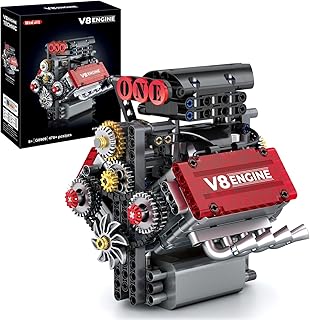
The 478-piece V8 engine kit provides a comprehensive, battery-powered build that culminates in a runnable mini engine. It emphasizes mechanical accuracy with pistons, timing gears, and a realistic crank assembly. The kit is ideal for more advanced learners who want a deeper dive into multi-cylinder engineering. It offers an opportunity to compare theoretical concepts with tangible outcomes, reinforcing lessons on energy transfer, synchronization, and the role of each component in engine function.
Assembly requires careful attention to alignment and sequence, which helps develop problem-solving skills and patience. The finished model demonstrates how an eight-cylinder configuration behaves under power and how various subsystems—such as exhaust manifolds and drive belts—integrate into a functioning whole. While more complex than beginner sets, this kit remains approachable for motivated students and hobbyists seeking a substantial hands-on project.
Engine Building Kit, 42pc (Blue)

This 42-piece kit provides a compact, interactive engine build experience. It features a replaceable electric drill, a real action screwdriver, and a motorcycle engine focus, delivering audible and visual cues to enhance immersion. The design offers a practical introduction to basic engine components and how nodes connect within a simple system. The included electronic elements simulate realistic starting sounds and jet-like effects when water is added to the exhaust, creating an engaging sensory experience for young builders.
As a beginner-friendly option, the blue engine kit encourages exploration without overwhelming complexity. It serves well as a gift for early STEM learners or for quick, educational play sessions that still convey core concepts such as cause-and-effect, component roles, and assembly order. The toy’s durability and interactive features support sustained interest and hands-on learning in STEM activities at home or in the classroom.
W16 Engine Building Blocks Set

The W16 Engine Building Blocks Set is a large, 801-piece build designed for advanced builders who enjoy LEGO-style compatible construction. This set supports a high-fidelity, multi-cylinder engine with robust block connections, enabling a substantial hands-on project that fosters spatial reasoning, planning, and mechanical understanding. The extensive piece count allows for a deeply layered model, encouraging learners to map out subsystems like fuel delivery, exhaust, and timing within a brick-based framework. The result is a durable, highly immersive visual approximation of a complex engine system.
As a long-term STEM project, the W16 kit invites experimentation with scale, component placement, and modular design. It suits family projects, classroom demonstrations, or independent study for teens and adults who want a challenging, high-detail engine model. A compatible brick-building approach also helps learners translate concepts from traditional engine schematics to physical, brick-built representations.
V991 Transform Remote Control Car

The V991 Transform Remote Control Car offers a different kind of engine-related engagement, focusing on motion control, gesture sensing, and deformation features. While not a traditional engine kit, it complements engine-themed play by illustrating automotive dynamics and robotics concepts. With a 1:10 scale, the car includes two rechargeable batteries and a responsive remote control system, making it suitable for older kids and teens who enjoy technology-driven STEM activities. The product emphasizes practical applications of engineering in motion, control, and user interaction.
For learners seeking a broader view of motion systems, this RC car demonstrates how electrical power, control logic, and mechanical design come together to produce dynamic performance. It can serve as an introduction to sensors, actuators, and programming concepts in a tangible format, aligning with lessons on automation and robotics within a broader engine-building theme.
Buying Guide: Key Purchase Considerations For Toy Engine Kits
- Age and Skill Level: Choose kits aligned with the builder’s age and experience. Beginners benefit from smaller part counts and guided assembly, while advanced builders may enjoy multi-cylinder, high-piece-count sets with realistic mechanisms.
- Educational Goals: Consider whether the kit emphasizes mechanical concepts (pistons, timing, crankshaft), energy transfer, or hands-on problem solving. Some sets include electronic components or sound effects to reinforce learning.
- Power and Operation: Decide between battery-powered models that run automatically, as with many V8 kits, and purely mechanical assemblies that require manual cranking. Battery-powered options often offer more immediate feedback and replayability.
- Compatibility and Expansion: Large brick-based sets (like the W16 kit) can augment existing LEGO-like collections, enabling modular expansion and interoperability with other builds for broader STEM exploration.
- Durability and Safety: Look for well-made plastics, secure fasteners, and clear instructions. For younger children, easier assembly and fewer small parts reduce safety concerns and frustration.
- Educational Support: Some kits include manuals, online tutorials, or lesson ideas that align with science standards. These resources can help teachers and parents structure structured activities or assessments.
- Maintenance and Accessibility: Consider the availability of replacement parts, availability of batteries, and ease of disassembly for learning through teardown and rebuilds.
- Budget and Time Investment: Complex kits offer deeper learning but require more time and patience. Balance the desired learning outcomes with the amount of time a builder can invest.
Each kit below presents a distinct balance of realism, complexity, and interactivity. When selecting, weigh the learner’s interests—engine mechanics, brick-building, or robotics—and how the kit might integrate with other STEM activities at school or home. The right choice should encourage curiosity, sustain engagement, and provide measurable progress toward understanding engine design and mechanical systems.
Leave a Reply