Best Tiny Gas Engine Kit Sets for Hands-on STEM Fun and Realistic Mini Engines
For hobbyists, students, and curious minds alike, tiny gas engine kits offer a compelling blend of education and hands-on creativity. These kits showcase working mini engines that reveal how pistons, valves, and crankshafts collaborate. In this guide, five top options emulate real engines with working or highly realistic components, helping learners visualize mechanical systems while supporting STEM curiosity. Read on to compare features, setup, and how each kit supports learning goals—from classroom demonstrations to solo tinkering.
| Product | Brand | Notable Feature |
|---|---|---|
| Playz V8 Combustion Engine Model Kit | Playz Store | Working mini V8 with visible pistons and engine sounds |
| Model Engine Kit for Adults – L2 Mini | TOYAN | Gas-fueled twin-cylinder 4-stroke with advanced valve function |
| Mould King Mini V8 Engine Kits | Mould King Store | Transparent cylinder head and realistic turbocharger |
| Nifeliz Turbofan Engine Building Set | Nifeliz | Large-scale engineering challenge with 2,216 components |
| V8 Engine Model Building Kit That Runs | BseSparklion Store | USB-rechargeable motor for a battery-free operation feel |
Playz V8 Combustion Engine Model Kit

Hands-on learning takes center stage with this visible V8 engine model. The kit invites both adults and younger builders to assemble a working replica of an eight-cylinder engine. It integrates real engine components like pistons and interactive cables, delivering a tangible connection between theoretical concepts and practical application. When powered by three AA batteries (not included), the engine fans spin and produce authentic engine-like sounds, enriching STEM exploration and maintaining engagement during long build sessions.
The kit’s design emphasizes a complete assembly experience, including cranks, pulleys, belts, and exhaust valves. This setup supports constructive problem-solving as builders chase smooth synchronization of moving parts, helping learners observe how timing and mechanical relationships affect engine performance. This option is especially suitable for classrooms or family projects where visualizing engine operation supports core physics and engineering outcomes.
TOYAN FS L200AC Mini Engine Kit

This model emphasizes realism and durability with a high-fidelity two-cylinder, four-stroke design. Aluminum CNC processing and oxidation coloring deliver a premium look that mimics a real powerplant. The kit uses a dual synchronous belt pulley system to reduce gear-jump risks at higher speeds, while a compact rocker arm design improves valve operation fidelity. An advanced carburetor and a high-torque DC motor provide straightforward electrical starting, ensuring consistent power delivery and smoother throttle response for learners studying engine timing and control systems.
Mould King Mini V8 Engine Kit 10171

Another standout V8 kit features a transparent cylinder head and dynamic piston motion, letting builders observe the inner workings of a modern V8. A turbocharger detail adds an extra layer of realism for enthusiasts who value accurate mechanical representation. The kit appeals to both serious hobbyists and collectors who want a visually compelling display piece along with functional engine movement, making it a strong fit for STEM classrooms or maker spaces focused on automotive engineering concepts.
Nifeliz Turbofan Engine Building Set

The Nifeliz Turbofan Engine Building Set stands out for its sheer scale and depth, housing thousands of pieces that challenge builders to assemble a functioning turbofan-inspired model. While primarily a display and educational project, its engineering complexity offers insights into large-scale propulsion systems, material selection, and assembly sequencing. This kit is ideal for adults and collectors who enjoy intricate mechanical builds and long-term projects that emphasize precision, spatial reasoning, and systems integration.
V8 Engine Model Building Kit That Runs
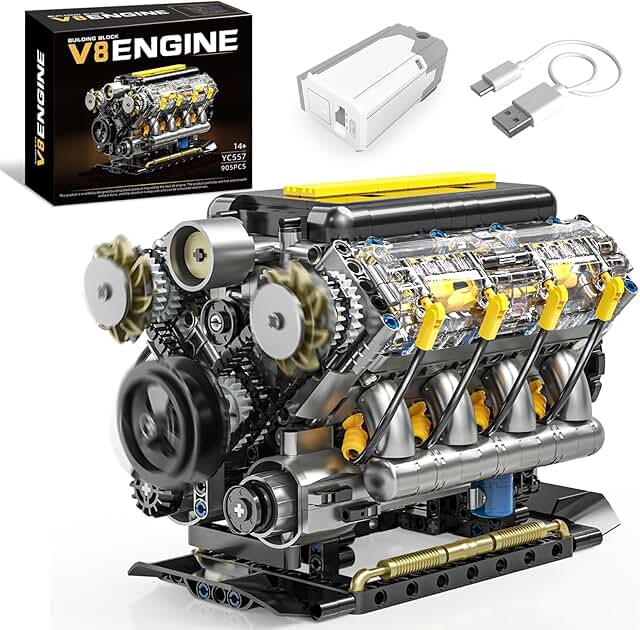
This kit emphasizes realistic operation and user-friendly power. It replicates an eight-cylinder engine with moving pistons, a functional valve train, turbocharger, and exhaust system. The design supports demonstrations of engine dynamics and internal combustion principles, appealing to both students and hobbyists who want a tactile understanding of how an engine performs. A two-speed USB rechargeable motor powers the model, eliminating the need for batteries and offering a cleaner, more sustainable demonstration of engine motion while keeping the experience accessible and engaging for home learning or classroom use.
Buying Guide: Key Considerations For Tiny Gas Engine Kits
- Purpose and audience: Choose a kit aligned with the learner’s age and goals—introductory visual demos for kids, or detailed, functional models for teens and adults.
- Power and starting method: Some kits use batteries, others USB-powered motors. Consider how power affects reliability, noise, and setup convenience in your space.
- Realism vs. display: Decide if you want a working engine with moving parts, or a highly detailed, visually realistic model for display and study.
- Build complexity and duration: Some sets are quick to assemble, while others are multi-day projects. Match complexity to the builder’s patience and skill level.
- Materials and durability: Aluminum, metal components, or high-grade plastics affect longevity and tactile feel—important for frequent handling or classroom use.
- Educational value: Look for sets that illustrate core concepts like piston motion, valve trains, timing belts, and combustion cycles to maximize learning outcomes.
- Compatibility and expansion: Some models can be integrated with other kits or LEGO- or model-building ecosystems, increasing long-term value and creativity scope.
- Safety and supervision: For younger builders, ensure appropriate age recommendations and supervise operations that involve small parts or engines.
When selecting a tiny gas engine kit, balance the educational goals with the user’s interest in mechanical detail and the time available for assembly. Each option highlighted above offers distinct advantages—from interactive working engines to highly realistic, scalable models that emphasize engineering principles and display quality. Consider your space, learning objectives, and the level of hands-on challenge you want to embrace.
Leave a Reply