Best Flash Cards for Kids: Top Learning Sets for Preschool & Kindergarten
Flash cards are classic tools for building early literacy, math, and everyday skills. This guide highlights five highly versatile flash card sets that engage young learners, support phonics, numbers, and basic math, and offer durable formats for classroom and at-home use. Each option includes clear visuals, age-appropriate content, and interactive elements to encourage active participation.
| Product | Key Benefit | Target Age |
|---|---|---|
| Carson Dellosa Toddler Flash Cards 4 Pack | Alphabet, sight words, colors, shapes, and numbers 0-25 | 2–5 |
| School Zone Alphabet Flash Cards | ABC foundational letters with phonics | 3+ |
| Carson Dellosa Addition/Subtraction/Multiplication Cards | Core math operations with structured practice | 8–12 |
| Award-Winning 5-Deck Set | Comprehensive topics: alphabet, numbers, colors, shapes, rhyming | 2–6 |
| Talking Flash Cards (Montessori Style) | Vocabulary with audio for speech development | 2–5 |
Best Toddler Flash Cards Bundle For Early Learning

The Carson Dellosa Toddler Flash Cards bundle delivers four compact packs designed for very young learners. Content spans alphabet recognition, first words sight words, basic colors and shapes, and numbers 0–25. The included resources promote phonics and math games to deepen engagement. The durable, compact cards are ideal for home centers, daycare activities, and classroom small-group work, giving educators flexible options for daily practice.
Bright Alphabet Practice With Colorful Cards

School Zone’s Alphabet Flash Cards provide a straightforward path to recognizing letters and building early phonics. With 56 cards, this set supports guided practice through repetition, letter-sound associations, and visual cues. The colorful, durable design is well-suited for small groups, homeschool sessions, and classroom centers. It’s a clean option when the focus is purely on letter identification and basic sound recognition.
Math-Focused Flash Cards For Grade School

This set centers on four essential operations—addition, subtraction, multiplication, and division. It’s designed for kids aged 8–12 and aims to strengthen mental math and fluency through targeted flash-card practice. Teachers and parents can use it to support homework routines, quick review sessions, or small-group math centers, helping students connect arithmetic concepts with quick recall.
Award-Winning Flash Cards For Preschool & Kindergarten
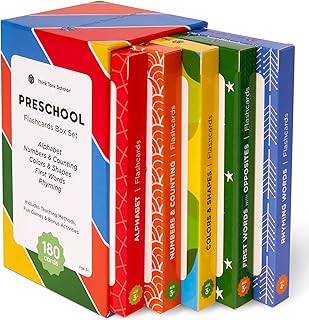
Think Tank Scholar’s 5-deck set provides a broad curriculum across essential early-learning topics: alphabet, first words, colors, shapes, numbers, and rhyming. The jumbo-sized cards (3.1” x 5.2”) are easier for little hands to handle, and coated finishes with angled edges make sorting and sorting practice smoother. Award recognition signals teacher and parent confidence in its educational value and durable design.
Talking Flash Cards For Toddlers

This Montessori-inspired talking set uses a reader to play 224 words with corresponding images and sounds. The device supports vocabulary expansion, speech therapy practices, and interactive learning. It’s particularly well-suited for children who benefit from audio-visual reinforcement and step-by-step auditory cues. The repeat function and adjustable volume help tailor sessions to individual needs, making it a versatile classroom or home tool for speech development.
Buying Guide: Key Purchase Considerations
- Learning objectives: Determine whether you need alphabet basics, foundational math, or language development. Some sets emphasize phonics, while others focus on numbers and operations.
- Age and skill level: Choose cards aligned to the child’s developmental stage. Younger toddlers benefit from picture-rich, letter-focused decks; older children may need mixed-content or multi-operation math sets.
- Durability and format: Look for sturdy card stock, rounded corners, and protective coatings if cards will be used by multiple kids or travel frequently.
- Engagement features: Interactive or audio components can boost participation for reluctant learners or children who respond to multisensory cues.
- Teacher and caregiver support: Sets with bundled activities, suggested games, or teacher notes aid consistent use in classrooms or home learning.
- Portability and setup: Compact bundles are easier to distribute in stations or centers, while larger sets can support full-group activities with minimal prep.
- Progress tracking capabilities: Some decks include additional resources to monitor mastery, such as quick assessments or milestone cards.
- Budget and value: Compare content variety, card quality, and included resources to gauge long-term value beyond immediate use.
Flash cards remain a flexible, scalable way to support foundational literacy, numeracy, and language development. When selecting a set, consider how it complements daily routines, whether home or classroom use, and how it can adapt as a child’s needs evolve. A balanced mix—letters, numbers, and everyday vocabulary—often yields the strongest early learning outcomes.
Leave a Reply