Best 3D Puzzles for 4 Year Olds: Engaging Montessori and STEM Toys
Discover 3D puzzles that blend hands-on play with early learning. These picks focus on 4-year-olds, combining spatial reasoning, fine motor skills, and imaginative exploration. Each option emphasizes safe materials, guided or open-ended play, and age-appropriate challenges to keep little minds engaged while building a solid foundation in math and critical thinking.
| Product | Brand | Key Focus |
|---|---|---|
| Wooden Montessori Russian Blocks Puzzle | Oppvoci Store | Montessori blocks, 42 pieces, 9 shapes |
| Coogam Wooden Puzzle Blocks Geometric Tangram | Coogam Store | 60 challenges, multiple shapes |
| Learning Resources STEM Explorers Brainometry | Learning Resources Store | Pattern blocks, brain games, fine motor |
| STEM Board Games Kids Toys Maze Brain Teaser | Olfrid Store | Logic road builder, wind-up cars, marble |
| FOIMAS 3D Puzzles for Kids | FOIMAS | Farmhouse animals and 3D dinosaurs |
Wooden Montessori Russian Blocks Puzzle
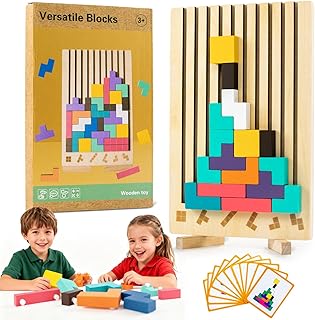
This changeable geometric puzzle uses classic Russian Blocks-inspired blocks to bolster spatial awareness and fine motor skills in children ages 3-6. The set includes 42 wooden blocks across 9 shapes, plus 10 double-sided cards (20 designs) for guided play. As kids stack and rotate pieces, they strengthen hand-eye coordination while practicing color and shape recognition. The Montessori approach emphasizes independent exploration, making it suitable for both boys and girls seeking screen-free learning moments.
Play options grow with the child: beginners can follow the pattern cards, while older kids can create their own 3D builds. The simple setup keeps playtime engaging across developmental stages without requiring extra equipment. The blocks are crafted from sturdy wood, offering a tactile, durable experience ideal for ongoing learning and imaginative construction.
Coogam Wooden Puzzle Blocks Geometric Tangram

The Coogam set arrives with 15 wooden pieces, a board, and a solution manual with 60 challenges. Difficulty scales from level 1 to 5, encouraging logical reasoning and spatial recognition as children progress. Higher levels introduce added complexity, such as removing a parallelogram piece to complete the puzzle. The wood is finely sanded and painted with a burr-free finish, designed for safe handling by small hands. This Montessori-style toy fosters problem-solving, color and shape awareness, and early math concepts.
Learning Resources STEM Explorers Brainometry

Brainometry challenges combine pattern matching with logic-based activities to boost critical thinking and early math skills for ages 5 and up. The set uses colorful pattern blocks to engage children in tactile, hands-on learning that builds spatial reasoning and fine motor coordination. Ten double-sided activity cards provide progressive difficulty, helping kids grow with the material and transition from guided to independent problem-solving as their abilities advance.
STEM Board Games: Maze Brain Teaser

This logic road builder blends puzzle blocks, tracks, wind-up cars, and a marble for interactive STEM play. Designed for kids aged 3–8, it offers 120+ levels across four difficulty tiers, enabling steady progression. The included guidebook supports structured play, while open-ended building lets children design their own routes. As kids plan routes, test solutions, and observe cause and effect, they develop spatial reasoning, problem-solving, and executive functioning in a hands-on, engaging format.
FOIMAS 3D Puzzles for Kids

FOIMAS offers a 31-pack of 3D puzzles featuring farmhouse animals and dinosaurs, crafted from EVA foam for lightweight durability. Each small puzzle piece fits into corresponding slots, promoting eye-hand coordination and cognitive development. The spread includes both farm and dinosaur themes, making it versatile for classroom prizes, party favors, or everyday educational play. The foam material is gentle on little hands, and the simple assembly supports early geometry and spatial understanding without requiring tools.
Buying Guide: Key Purchase Considerations
- Age appropriateness: Look for sets labeled for 3–6 years to match a 4-year-old’s developmental level and avoid frustration.
- Material and safety: Prefer wood or high-quality foam with smooth edges. Check for non-toxic finishes and burr-free surfaces to protect tiny fingers.
- Skill progression: Choose toys with multiple difficulty levels or expandable play—this ensures ongoing challenge as the child grows.
- Open-ended vs guided play: Montessori-inspired and modular sets offer guided patterns while still enabling independent exploration, which supports autonomy and creativity.
- Educational focus: Prioritize puzzles that build spatial awareness, fine motor skills, pattern recognition, and basic math concepts, complementing school readiness goals.
- Durability and portability: Compact, durable pieces travel well for car rides or classroom activities and withstand frequent handling by young kids.
- Storage and organization: A included box, bag, or tray helps keep parts organized and reduces loss during play and cleanup.
- Age-appropriate complexity: Ensure the set isn’t too easy or too challenging; look for visible progressions in level design to sustain interest.
- Theme variety: A mix of geometric and thematic puzzles (animals, patterns, maps) supports broader cognitive development and keeps curiosity high.
Leave a Reply